The 2 a.m. threshold
A machine you switch off at bedtime is a machine that does not work nights, and nights are when the bathroom does its damage. The whole argument for a quiet spec is that the room gets held for all twenty-four hours, not the twelve you are awake for. That is what the TZ-C2 night mode is for: under 30 decibels, the plate keeps condensing at 2 a.m., and nobody in the bed hears it doing so.
You already know the arithmetic of sleep. You measure it in hours stolen from the margins of the day. You know that a dehumidifier rattling at forty decibels is a dehumidifier that gets unplugged by Wednesday. An air purifier that whines on the nightstand is an air purifier that gets moved to the hallway by Thursday. In the hallway, it cleans the air of the hallway while you sleep behind a closed door. The mold in the bedroom corner continues to bloom. The dust in your breathing zone remains. The machine has been exiled by its own noise.
The quiet spec is not a luxury. It is the difference between a machine that stays in the room and a machine that gets exiled. We have built the ToLife way around this arithmetic: since 2022 we have made only quiet air machines, and partner factories build them to our drawings. We test for the register of a library at midnight, because that is when you need the machine to keep working. The EPA reminds us that wet materials should be dried within twenty-four to forty-eight hours to prevent mold growth. A machine that sleeps when you sleep misses half that window.
How to read a decibel
The decibel scale is logarithmic. Ten decibels is ten times the sound intensity, but your ear hears loudness, not intensity, and a difference of about ten decibels reads as roughly twice as loud. That is the only math you need here: on the TZ-C2 it is the gap between powerful mode at its loudest and night mode, one perceived halving.
About thirty decibels is the sound of a library or a soft whisper. It is the threshold where most people stop noticing sound. It is not silence. It is the level at which a noise becomes texture rather than interruption. If a machine runs at forty decibels, it sits ten decibels above that texture line. It is roughly twice as loud as the thirty-decibel mark. That is the difference between a presence you ignore and a presence you check. You check it by waking up. You check it by nudging the machine. You check it by unplugging it.
The EPA notes that indoor humidity should stay below sixty percent, ideally between thirty and fifty. The key to mold control is moisture control. A dehumidifier that gets unplugged at night misses eight critical hours: at the stated pace of up to a liter a day, that is a third of the day's extraction gone. The humidity rises, and the damp gets its hours back. The machine did not fail; the noise made you turn it off.
Why thermoelectric stays quiet
Compression-based dehumidifiers grunt. They cycle. They thump when the compressor kicks in to compress refrigerant. That thump travels through floor joists. It wakes light sleepers. It trains you to anticipate the next cycle. We chose thermoelectric condensation for the dehumidifier shelf because it removes the moving parts that make noise.
The physics are simple. A semiconductor plate chills below the dew point through the Peltier effect. Moisture condenses on the cold side of the plate and drips into the tank. One fan pulls air across the plate. That is the only rotating element. There is no compressor to rattle. No refrigerant lines to gurgle. No violent phase changes to shock the air.
The TZ-C2 runs that single fan at two speeds. In powerful mode, the fan moves enough air to extract up to one thousand milliliters per day at eighty-six degrees Fahrenheit and eighty percent relative humidity. That speed costs some noise. The fan spins faster. The air rushes. In night mode, the fan slows. The machine drops under thirty decibels. It becomes the texture of a library. There is no compressor to rattle the floorboards. Just the whisper of air over a plate.
This is the thermoelectric trade. It extracts less per day than a compressor unit of the same size would, but it extracts continuously. It extracts while you sleep. It runs in a nursery at the register of a whisper. It holds the bedroom without triggering the exile reflex: less water per day than a compressor takes, collected continuously, with the 95-ounce tank keeping score of what the night gave up.
The sound settings
Here is how our machines register on the scale.
| Machine and mode | Stated level | When it earns its keep |
|---|---|---|
| TZ-C2 powerful mode | 30 to 40 dB | When humidity is high and the room is empty |
| TZ-C2 night mode | under 30 dB | When you are in the room and the lights are out |
| TZ-K2 sleep mode | no figure published, the lowest fan step | When you want the quietest operation from the purifier |
The gap between powerful and night mode on the dehumidifier is roughly ten decibels at the top end. That means powerful mode can sound about twice as loud as night mode. You choose the mode based on occupancy. You run powerful mode when you are out at work. You run night mode when you are in bed. The machine earns its keep by adapting to the room's schedule rather than forcing the room to adapt to the machine.
What sleep mode changes
The TZ-K2 air purifier uses an H13 three-stage filter stack. The EPA states that HEPA filters can theoretically remove at least 99.97 percent of airborne particles at 0.3 microns. You can read more about that particle size in what 0.3 microns means. The stack includes a nylon pre-filter, the H13 layer, and activated carbon. It is rated for up to six thousand hours of operation.
Sleep mode on the TZ-K2 drops the fan to its lowest step. No decibel figure is published for that step; it is simply the quietest the machine runs. The black model includes an air-quality indicator that shifts from green to yellow to red based on particulate load. In sleep mode, you might want that light dimmed. The white model has those indicator lights removed altogether. It is built specifically for dark bedrooms where any glow is an intrusion.
Sleep mode holds the lowest fan step, full stop. On the black shell, auto mode ramps the fan whenever the indicator shifts; switch to sleep and the machine stops reacting, so nothing surges at three a.m. when the heater stirs up dust. Less reaction, more predictability: that is the whole trade.
Published owner reviews confirm the priority:
"I especially like the sleep mode because it operates quietly at night without being disruptive."
"At night you can put it in night mode and the noise it makes is virtually silent."
Quiet, not silence, is the claim: a sound level that still lets you hear the radiator ticking or the rain on the window, a presence that does not demand attention, a machine you forget is there.
Light is part of the budget
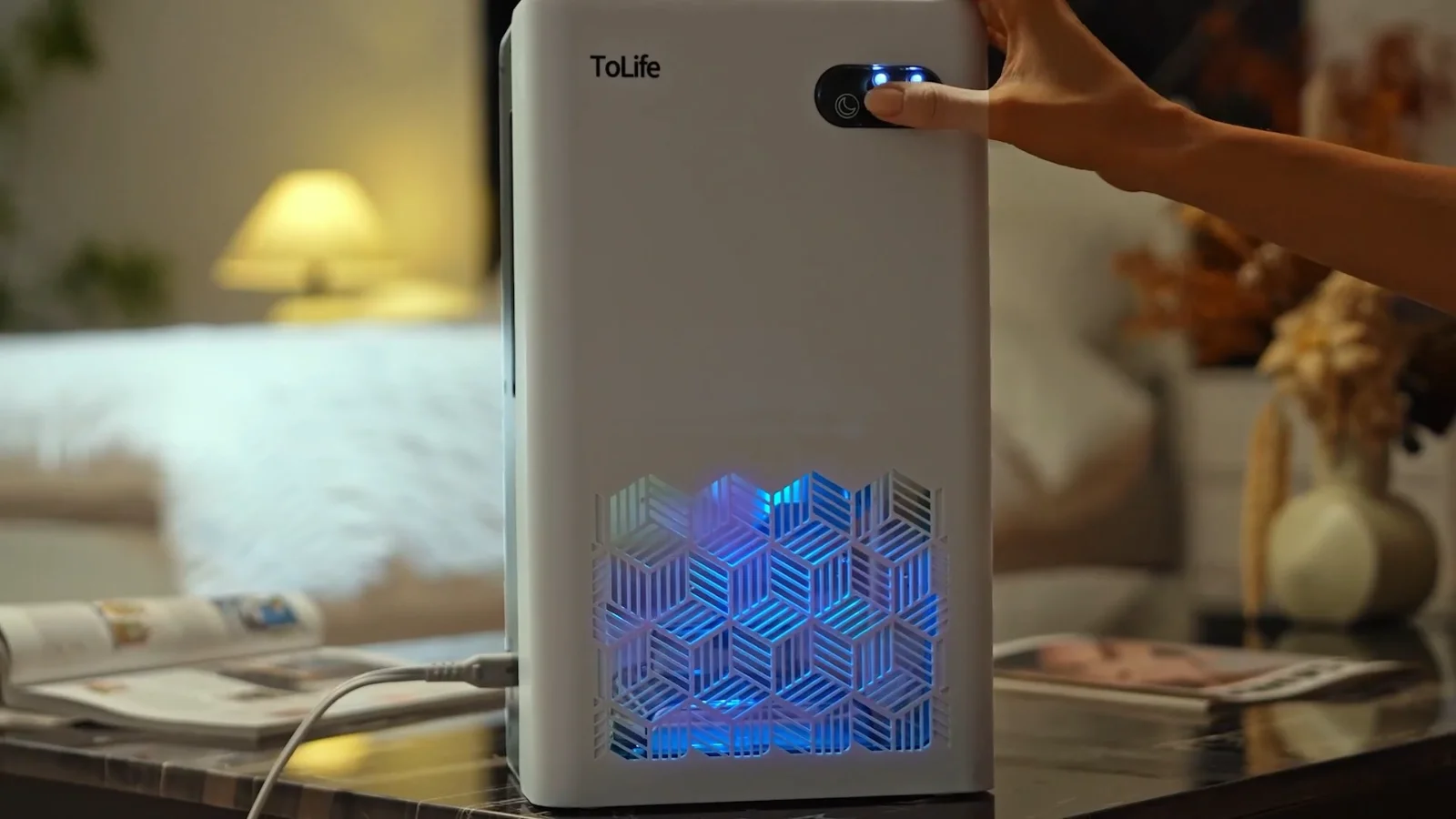
Sound is not the only stimulus that wakes you. A glowing display at two a.m. is a lighthouse in a dark room. Your eyes track it. Your brain registers the change in luminance. The TZ-C2 dehumidifier includes a seven-colour ambient light panel. You can lock it to one colour or switch it off entirely: some sleepers need absolute dark, others use the glow as a night-light for pathfinding. The switch is one button on the top panel.
The white TZ-K2 air purifier takes this further. We removed the indicator lights altogether. There is no glow to show power status, no color shift to report air quality. You operate it by touch memory. You know it is working because the air smells neutral by morning. The absence of light is as deliberate as the lowering of fan speed. Both are concessions to the sensory budget of the sleeping room.
You manage this budget with placement, too. A machine on the nightstand is inches from your ear. A machine on a shelf across the room loses part of its voice to distance before the sound ever reaches you. We design for shelf placement. The TZ-C2 stands 13.78 inches tall. It fits where books fit. The compact silver dehumidifier at nine by six by six inches fits even tighter spaces. Distance is free noise reduction. Use it.
Honest limits: under 30 dB
We state that the TZ-C2 runs under thirty decibels in night mode. We do not call it silent. A very light sleeper in a dead-silent room may still hear the fan. It is a soft whisper, but whispers carry in cathedrals. In a room that is truly still with the windows closed, you will notice when the machine adds its voice. You will not be startled. You will not be annoyed. But you may be aware.
Placement is part of the answer. You set the unit on a stable surface, not the floorboards that transmit vibration. You leave clear space around the intake and exhaust. You avoid placing it in an acoustic corner where two walls focus the sound toward the bed. You treat the machine like a roommate who sleeps lightly. You give it space. You do not put it under your pillow.
The tank size also affects the schedule. The TZ-C2 holds ninety-five ounces. You can read about the capacity math in the 95-ounce question. A larger tank means fewer interruptions. The machine runs steady until full, then shuts off automatically. The auto shut-off is silent. No beep wakes you. You empty it in the morning. The capacity lets the machine work the full night without asking for attention.
The ownership arithmetic
Fourteen thousand two hundred fifty-one published owner ratings inform our drawings, and we read them for patterns rather than praise. The clearest pattern became a product decision: enough owners mentioned indicator glow in dark bedrooms that the white TZ-K2 now ships with no indicator lights at all. A machine kept in the bedroom must respect the hours between ten p.m. and six a.m., because those are the hours nobody opens the door.
The EPA notes that portable air cleaners reduce indoor pollution but cannot remove all of it. Source control and ventilation come first. Filtration works alongside them. We build the filtration that works while you sleep, and no medical outcome is promised anywhere in it. What is promised: the machine runs its arithmetic of air and decibels while you are unconscious, and it does not wake you to tell you it is working.
The night sequence is short. You pick night mode on the dehumidifier or sleep mode on the purifier, lock the light to one colour or none, put the machine on a shelf rather than the nightstand, and empty the tank with the morning coffee. We founded ToLife in 2022 to make that sequence boring. Partner factories build the machines; we test them at midnight; you sleep through the result.
Check the specs at the purifier section and the dehumidifier shelf. Compare the decibels. Then let the machine work the full twenty-four hours. That is the ToLife way.
What we read before writing this page
- US Environmental Protection AgencyAir Cleaners and Air Filters in the Home · Portable air cleaners reduce indoor air pollution but cannot remove every pollutant; source control and ventilation come first, filtration works alongside them.
- US Environmental Protection AgencyA Brief Guide to Mold, Moisture and Your Home · The key to mold control is moisture control: indoor humidity below 60 percent, ideally 30 to 50; dehumidifiers are named as a tool; wet materials dried within 24 to 48 hours.
Each document above was read in full on August 27, 2026; the reading dates for every page live on our updates page.