Where the water comes from
You do not need a leak to have a wet room. The water is already inside your house, hiding in the air you breathe out, the steam from the kettle, the towel that never quite dries by evening. A single shower can load a small bathroom with more moisture than the paint and grout can hold. If the room has no vent, that moisture has nowhere to go. It settles on the mirror first. Then it reaches the ceiling. Then it finds the inside of the cabinet where your spare toothpaste sits.
Drying laundry indoors turns a bedroom into a slow sauna. A rack of wet jeans and cotton shirts can pump water into the air for hours. Cooking sends plumes above the stove that the range hood never fully catches, especially in open-plan apartments where the steam drifts toward the sofa. Even breathing adds up. Two people sleeping behind a closed door load the air with humidity that condenses on the inside of the window by morning.
Concrete basement walls drink from the ground after heavy rain. The moisture does not always arrive as a puddle. Sometimes it is only a darkening of the block. Sometimes it is a mineral stain. Sometimes it is a smell you notice when you first walk downstairs. You can feel it in the sheets. You can smell it in the closet. You can see it on the cold water pipe sweating against the basement ceiling.
Seasons exaggerate the load. Summer air holds more water to begin with, so the baseline humidity starts higher. Winter brings cold surfaces that pull moisture out of the air and deposit it on window frames and exterior walls. The house is always breathing in one direction or the other.
The EPA notes that indoor humidity should stay below 60 percent, ideally between 30 and 50. The key to mold control is moisture control, and wet materials should be dried within 24 to 48 hours. Their guidance is public: a brief guide to mold, moisture and your home. A dehumidifier does not replace a vent fan or a repaired gutter, but it buys you time. It pulls water from the air while you figure out the larger fix, or it holds the line in rooms where a larger fix is not possible.
Reading the tank honestly
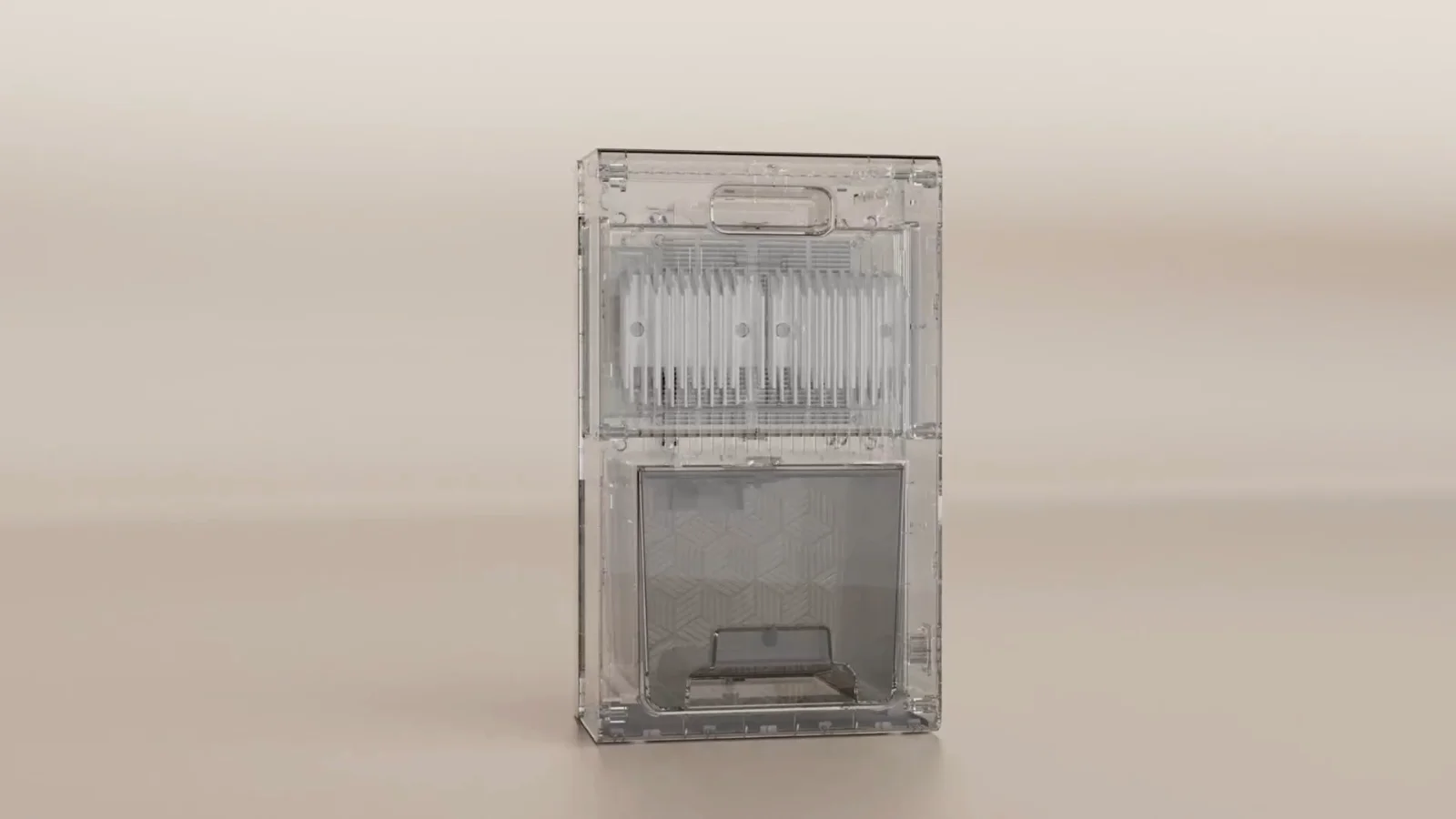
A 95-ounce tank is not a bucket. It is a large water bottle, the kind you might carry on a long hike. In metric terms, that is 2.81 liters, or about 2,800 milliliters. It fits inside a machine that stands 13.78 inches tall. You could place it on a nightstand or a basement step without blocking the walkway.
When you lift the full tank, you feel the weight of the air you have been breathing: 2.8 liters of water is about six pounds in the hand. Heavy enough to notice. Light enough to carry flat to the nearest sink, pour, and slide back. A watering can works just as well as a drain, and the plants will not complain.
The size is deliberate. A larger tank means a larger, louder box; a smaller one asks for a daily trip to the sink. Ninety-five ounces holds two to five days of a real room, and the shelf still has space for books.
The arithmetic of a week
The TZ-C2 line carries our stated extraction figure of up to 1,000 milliliters per day, measured at 86 degrees Fahrenheit and 80 percent relative humidity, a condition that mimics a steamy bathroom or a damp midsummer basement more than a climate-controlled bedroom.
At that full pace, the 2,800-milliliter tank reaches capacity in 2.8 days. Call it roughly three days if you round up, or two and a half if you are being conservative. In a milder room, where the machine extracts closer to half that rate, the interval stretches to about five or six days. Half of 1,000 milliliters is 500 milliliters. At that rate, the 2,800-milliliter tank needs 5.6 days. That is the difference between a room that is actively steaming and a room that is merely occupied.
These are not guarantees. They are benchmarks to help you plan. You will not set a calendar alert for 2.8 days. Instead, you will learn the feel of the room. After a week, you know whether you are living in the high-extraction zone or the slow-and-steady zone. The machine has an auto shut-off at a full tank, so the only risk is a pause in operation, not an overflow. You can leave the house for a long weekend and return to a machine stopped at full, waiting. You can empty it on Sunday night and know whether you will need to empty it again by Wednesday or by Friday.
Room by room
Not every room writes the same diary. A bathroom with daily showers and no exhaust fan loads the air far faster than a spare bedroom where the only moisture source is human breath. The table below maps a few common scenarios to the emptying rhythm you can expect, using only the arithmetic we have. We have grouped rooms by the load they place on the machine, then translated that load into days between trips to the sink.
| Room | What loads the air | Days between emptyings |
|---|---|---|
| Unvented bathroom | Daily showers with no exhaust fan | About 2.8 days |
| Basement corner | Concrete walls after rain, limited airflow | About 2.8 days |
| Laundry nook | Wet clothes drying on a rack | About 2.8 days |
| Small bedroom | Breathing, normal occupancy, closed windows | About 5 to 6 days |
| Kitchen | Boiling water, occasional cooking steam | About 5 to 6 days |
The table is honest about the overlap. A kitchen can spike higher during a pasta boil. A basement might calm down in dry September. A bedroom with two occupants and a drying towel on the door might behave more like the bathroom column. What the numbers give you is a starting point. You place the machine. You wait for the first full tank. Now you know your own schedule. The 1,000-square-foot rating on the box is the maximum area the fan can effectively stir. In practice, the tank size tells you more about the match than the square footage does. If you are filling every two days, the room is winning. If you are filling every six, the machine is holding the line comfortably.
What "up to" really means
The phrase "up to 1,000 ml per day" is doing more work than it appears. It is a ceiling, not a promise. Most rooms in most seasons will run closer to half that rate. We do not control your local humidity, the temperature of your walls, or how long your teenager spends in the shower. What we control is the thermoelectric core and the fan that draws air across it.
Thermoelectric condensation works by cooling a surface below the dew point. When the air is already warm and heavy, the process is efficient. When the air is cooler or less saturated, the extraction rate falls. This is physics, not a flaw. A semiconductor machine trades the brute force of a compressor for silence and a lighter footprint. You sacrifice speed for decibels and desk space. That trade makes sense in a bedroom. It makes sense in a closet. It makes sense in a small bath. It makes less sense in a flooded crawlspace.
A compressor dehumidifier pulls many times more water in a day. It is also a two-hand carry, sounds like a small refrigerator, and vents warm air. That is appropriate for a disaster. It is overkill for a bathroom.
We mention this because sizing honestly means knowing where the line is. Our machines are not failed compressors. They are a different category, built for a different set of problems. If your room is under 1,000 square feet and the job is up to a liter of water a day, the arithmetic above holds. If the job is drying out construction after a pipe burst, it does not.
When thermoelectric is enough
Let us be direct. A basement with standing water, a foundation leak, or a crawlspace that floods every spring needs a compressor dehumidifier. Those machines are loud, heavy, and effective. They are the right tool for emergencies.
Our machines are built for the quieter crisis. The room that never quite dries. The bathroom with no vent. The closet where leather starts to smell. The TZ-C2 draws air through semiconductor condensation, runs at 30 to 40 decibels in powerful mode, and drops below 30 decibels in night mode. We have written elsewhere about why quiet as a spec matters more than marketing copy usually admits. At under 30 dB, the sound blends into the background of a dark bedroom. You stop noticing it after the first week.
It also carries a seven-colour ambient light panel, though many owners run it dark. The light can cycle through its range or hold a single hue. Some owners use it as a night light. Others turn it off entirely. The control is a small button on the top panel. The auto shut-off means you can leave for the weekend without returning to a puddle. The machine stops, waits, and resumes when you empty the tank. The footprint is small enough to sit on a window ledge or a stack of storage boxes. A studio apartment where the owner sleeps ten feet from the machine, a nursery where a compressor drone is out of the question: these are the rooms our machines were drawn for.
Three bodies, same job
The TZ-C2 comes in four colours. Grey and Black list at $59.96. Silver and White & Black list at $59.99. The body is the same 8.27 by 5.55 by 13.78 inches. The tank is the same 95 ounces. The only difference is the finish.
If you want the same 13.78-inch body in a pure white shell with the ambient light panel, the Dehumidifier with Ambient Light in White lists at $59.96. It handles the same square footage and runs the same core.
For tighter spaces, the Compact Dehumidifier in Silver is shelf-sized at 9 by 6 by 6 inches. It lists at $64.99. The smaller body fits a single closet. It fits a camper. It works on a bathroom counter with no free floor space. You trade some tank volume for placement flexibility.
You can see every current model on the dehumidifier shelf. The prices listed here are the figures we have updated most recently.
What owners report
We have 14,251 published owner ratings across the ToLife range. Fourteen thousand two hundred fifty-one ratings is not a claim of perfection. It is a measure of scale. Enough people have lived with these machines long enough to leave a note. The comments that matter most to us are the ones that describe a rhythm. Here is what two owners wrote about living with their machines.
"I have an old house with no vent in bathroom I run it 24/7 and it fills up with in a week especially when it's humid outside. It shuts off automatically and then I just empty tank and restart it."
That review lines up almost exactly with the arithmetic. An unvented bathroom in humid weather pushes the machine toward its higher extraction rate. The tank fills in roughly a week, which splits the difference between the 2.8-day peak and the slower baseline depending on how many showers and how much outside air is creeping in. The auto shut-off is doing its job. The owner has learned the rhythm. Empty, restart, repeat.
"Absolutely love this. Our humidity in the house went from being in the high 60s to low 70s to staying in the high 40s low 50s."
That drop from the high 60s and low 70s down to the 40s and 50s is the zone the EPA recommends. Damp loses its foothold, and the window frames stay dry by morning. The machine did not perform surgery on the house. It just removed water faster than the house added it.
The rest of the air
Removing moisture is half the battle for some rooms. For others, the concern is particles. We also build H13 air purifiers with a three-stage stack. If you want to understand the scale of what those filters catch, we have explained what 0.3 microns means in a separate piece.
Water and particles travel together in an enclosed house. A dehumidifier keeps the humidity line where you want it. A purifier handles what is floating. Between the two, you can hold a room steady without dramatic intervention. Neither machine is a treatment for asthma or allergies. Source control comes first. Fix the leak. Run the vent fan when possible. Crack a window when the weather allows. Then let the quiet machines hold what you have fixed.
You can browse both lines at the ToLife range. We keep our figures current on our updates page. Empty the first full tank, note the day, and you will know your room better than any chart on this page.
What we read before writing this page
- US Environmental Protection AgencyA Brief Guide to Mold, Moisture and Your Home · The key to mold control is moisture control: indoor humidity below 60 percent, ideally 30 to 50; dehumidifiers are named as a tool; wet materials dried within 24 to 48 hours.
Each document above was read in full on August 27, 2026; the reading dates for every page live on our updates page.